
Bagader Trading
Tyres, tubes and batteries. Largest stockist of Chinese, Indian and Indonesian Tyres, Korean Tubes and Batteries and a leading exporter of tyres to Africa from Dubai...



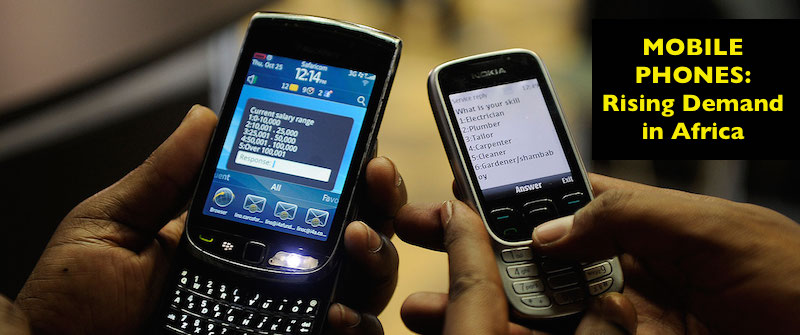
When it comes to mobile phones, Africa is truly undergoing a revolution. A new study
shows that Africa is the first continent to have more mobile phone users than
fixed-line subscribers. Mobile phones have revolutionised Africa during the last
years: more Africans have begun using phones since the year 2000 than in the whole
of the previous century.
The International Telecommunication Union (ITU) presented new statistics on the
telecom sector in Africa at the recent Africa Telecom conference held in Cairo.
According to the ITU survey, Africa has also become the world’s
fastest-growing mobile phone market. Over the past five years the continent’s
mobile phone use has increased at an annual rate of 65 per cent, which is twice the
global average. This is good new for telecom investors in Africa.
The actual growth in mobile phones has been far larger than expected by international experts and investors. A major reason for the boom is that Africa lags far behind other continents when it comes to fixed-line phone subscribers. Only 2.8 per cent of Africans have ordinary phone services.
In the generally sparsely populated and extensive African continent, where the majority population lives in poverty, the large costs of stringing up telephone wires so far has not been economically viable. Mobile phone networks, on the other hand, are much cheaper and faster to establish. As a result, some 6 per cent of Africans now use mobile phones; more than double the number of fixed-line phone subscribers.
The establishment of mobile phone networks has also defied structures hostile to investments, warfare, failed states and natural disasters. Somalia, which has not had any central government for over a decade, has achieved a vibrant mobile industry. Mobiles have steadily advanced in Congo Kinshasa and Liberia despite heavy warfare.
Phone masts tower above cities such as Cape Town and Cairo, war–torn capitals
such as Mogadishu and Monrovia, rural villages never touched by telephone lines and
even remote refugee camps such as Kakuma in northern Kenya, where text messages and
irritating ringtones are now as much a part of life as food handouts.
This remarkable growth — the African market is expanding nearly twice as fast
as Asia’s — has confounded analysts and even service operators. The ITU
forecast that there would be 500 million users by the end of 2025.
Before mobile phones, vast swaths of Africa were communication voids. There are just
three landlines per hundred Africans  and most are expensive and unreliable. By contrast,
Europe has 40 fixed phones per 100 people.
and most are expensive and unreliable. By contrast,
Europe has 40 fixed phones per 100 people.
The GSM handset market in Nigeria is currently undergoing an unprecedented boom. Shipments of new GSM phones are forecast to rise almost 60 per cent by 2025 making Nigeria the largest market in Africa for GSM phone sales thereby displacing South Africa from the number one spot. It is estimated that just 35 per cent of Nigeria’s population has a mobile phone – a useful insight to gauge the Nigerian market’s enormous potential as a growing market for GSM handsets.
South Africa, on the other hand, with its booming economy, is Africa’s biggest mobile phone market as of now, with nearly 25 million subscribers. South Africa is followed by Nigeria, Egypt and Morocco.
However, it is in less-developed countries that the statistics are most startling. The Democratic Republic of Congo, population 60 million, has 10,000 fixed telephones but more than a million mobile phone subscribers. In Chad, the fifth-least developed country, mobile phone usage jumped to 800,000 in three years.
A lack of electricity has not proved a hindrance: roadside vendors charge mobile phones with car batteries. As the signal coverage expands, cheaper phones and calls fuel growth.
Cell phones not only offer Africans new facilities through voice services but also
uses emerging technologies that bring Internet access to phones, thereby bypassing
the need for a computer for connecting to the World Wide Web. Since computers are
rare in much of the African continent due to poor wire-line infrastructure – a
recent study found 97 per cent of people in Tanzania said they could access a mobile
phone, while only 28 per cent could access a landline – and unreliable
electrical grids, a technology that offers Internet access without a costly PC
promises to pay dividends for Africans.
Sale of mobile phones in Africa is set to more than double in the next five years. The rise is expected to be bolstered by expansion of local and regional economies and more service providers rolling out networks across the region.
Increased demand for mobile phones is expected to provide phone manufacturers with a steady supply of customers as existing owners upgrade their models and new subscribers come online with increased network expansion.
Looking at the great demand for mobile phones in Africa and the rising sales figures throughout the African continent, an enterprising organisation in Zambia called M-Tech Mobile Communicartion has started assembling its own brand of mobile telephone handsets and has been promoting its brand throughout Africa.
"We believe in bringing technology closer to the African people by providing world class products ar competitive prices," says Mohaammed Seedat, managing director of Zambia-based M-Tech Mobile Communication. "The business potential of our venure is enormous as we will be meeting the rising demand for mobile handsets throughout Africa in the coming years," he says.
Previous Next
Tyres, tubes and batteries. Largest stockist of Chinese, Indian and Indonesian Tyres, Korean Tubes and Batteries and a leading exporter of tyres to Africa from Dubai...

Complete range of automobile spare parts, tyres, batteries and lubricants available for the tough, demanding driving conditions of Africa. A-MAP is one of the leading exporters of automobile spare...

Complete range of automobile spare parts, tyres, batteries and lubricants available for the tough, demanding driving conditions of Africa. A-MAP is one of the leading exporters of automobile spare...

Exedy Middle East FZCO manufactures a complete range of clutch and transmission solutions for a wide range of automobiles and machinery. Exedy clutches are in high demand in Africa...

Gifts, Novelties and Promotional Material supplier. Watches, Bags, Key Chains, Desktop accessories, Pen Sets, Gift Items... Wanted business partners in Africa...

Competitively priced tyres of almost all well known brands like Advance, Double Happiness, GT, Double Ox, Hankook etc. BBG Trading is a major exporter to African markets...

Distributor for Scania in the United Arab Emirates since 1981, has been registering a healthy growth in demand for genuine spare parts for trucks, buses and marine and industrial engines

Spare parts for all kinds of heavy machinery and equipment. Represents Hyster, Grove, Bobcat, Perkins, Massey Ferguson, Deves, Ausa, Sullair...

Manufacturer of quality soaps, cosmetics and toiletries for international markets and a leading exporter of beauty products and toiletries to Africa...

Manufacturer of quality steel furniture in Dubai - Steel Desks, Steel Filing Cabinets, Steel Cupboards, Steel Lockers, Steel School Furniture etc...

New Al Dhaid Furniture L.L.C. (NAD) offers a comprehensive range of home and office furniture and has emerged as a leading exporter to the African markets...

Ajmals has produced a special line of perfumes for the African markets. MARYAJ, a special range of budget-priced perfumes has already become popular with African customers...

Specialised supplier of kitchen equipment for hotels, restaurants and cafés. Seeking importers of kitchen equipment in Africa and buyers in African markets...

Everhot STAINLESS STEEL Water Heaters are much better than the conventional glass-lined water heaters as their inner tank is made from stainless steel...

Full range of Truck Chasis for all uses as well as standard and luxury buses and forklifts from 1 to 7 tons, with diesel, gasoline, LPG and battery operating systems...

One-stop source for all tractor and diesel engine parts in Dubai. Seeks business partners and wholesalers in Africa to further increase its client base in Africa...

Manufacturer of all kinds of plastic, paper and packaging materials. Seeks importers in Africa of packaging materials as well as cleaning chemicals...

Manufacturers of Fire Extinguishers, Fire Fighting Equipment and related products and equipment. Wholesale inquiries from Africa welcome. Distributors wanted...

Asimco is a leading manufacturer of premium friction products including brake pads, brake shoes, fuel pumps, brake fluids, disc rotors and shock absorbers...
