
Africa is the second-largest continent in the world, ranking second in both landmass and population. Covering about a fifth of the Earth's total land area, it is a region of unparalleled geographical, biological, and cultural diversity. Here are some of the most fascinating facts about the African continent.
Africa was once joined to other continents. Before the geological phenomenon of continental drift, Africa was the centerpiece of the supercontinent Pangea. It shares identical geological traits and fossil records with South America, India, and Antarctica.
The lowest point in Africa is Lake Assal. Located in central-eastern Djibouti, this spectacular crater lake sits 155 meters (509 feet) below sea level, making it the lowest point on the entire continent.
Africa is the home of the human species. Early humans first migrated out of Africa into Asia between 2 million and 1.8 million years ago. They entered Europe somewhat later. Species of modern humans populated other parts of the world much later, solidifying Africa as the evolutionary cradle of humankind.
The world's largest hot desert is the Sahara. Located in the northern part of Africa, the Sahara has a surface area of over 9 million square kilometers (3.5 million square miles), standing as the largest non-polar desert in the world.
Africa makes up nearly 20% of the world's population. Thanks to rapid growth, Africa's population has surpassed 1.58 billion as of 2026. Because of this population boom, a massive percentage of Africa's residents are under 30 years old.
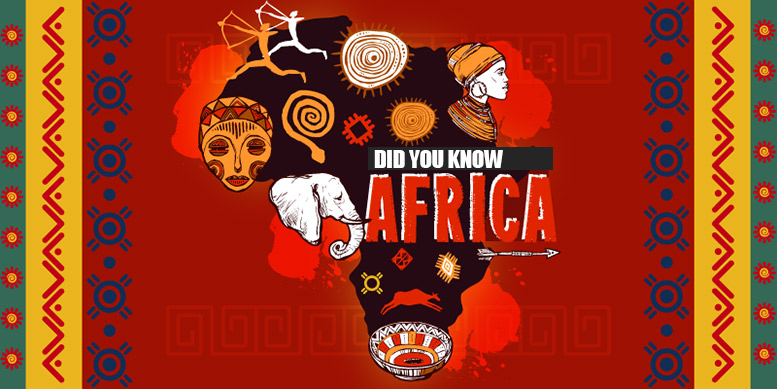
Africa is home to the largest known mammal. The world’s largest living land animal, the African elephant, which can weigh between 6 and 7 tons, is found in Africa. Male African elephants stand 3.2–4.0 m (10–13 ft) tall at the shoulder.
The Nile is the longest river in the world. Measuring about 6,650 km (4,130 miles) in length. Although usually associated with Egypt, only 22% of the Nile’s course runs through Egypt. It actively flows through 11 different countries.
Lake Victoria is one of the wonders of the world. It forms the largest lake in Africa and the second-largest freshwater lake in the world by surface area, covering 26,830 square miles (69,490 square kilometers).
South Africa has immense economic contrast. South Africa holds the distinction of having one of the world's most advanced, industrialized economies, while simultaneously grappling with the largest wealth gap between the rich and poor globally.
Unmatched linguistic diversity. The continent's cultural diversity is absolutely staggering, fully supporting over 2,000 distinct languages. This represents roughly a third of all the world’s languages, spoken exclusively in Africa.
The world's youngest demographic. Africa is the youngest continent on the globe. The median age is just 19.5 years old (compared to Europe’s 42 years), positioning Africa to be the driving global workforce of the late 21st century.
The Equator perfectly divides the continent. Africa is the only continent to stretch all the way from the northern temperate zone to the southern temperate zone, giving it a nearly symmetrical climate layout from top to bottom.
Madagascar has a completely unique ecosystem. The island nation of Madagascar is the fourth-largest island globally. Because it has been isolated for millions of years, over 80% of its flora and fauna—including lemurs—are found nowhere else on Earth.
The tallest free-standing mountain. Mount Kilimanjaro in Tanzania is not only the highest peak in Africa at 5,895 meters (19,340 ft), but it is also the tallest free-standing mountain in the world, completely unattached to any mountain range.
A continent of vast mineral wealth. Africa is arguably the most resource-rich continent on the planet. It contains approximately 30% of the Earth's remaining mineral resources, including the vast majority of the world's platinum, cobalt, and diamonds.
The Smoke That Thunders. Victoria Falls, straddling the border of Zambia and Zimbabwe, is one of the largest and most spectacular waterfalls globally. Its indigenous name, *Mosi-oa-Tunya*, translates beautifully to "The Smoke That Thunders."
A historic megacity boom. Africa is urbanizing faster than any other region in history. Cities like Lagos (Nigeria), Kinshasa (DRC), and Cairo (Egypt) are rapidly expanding megacities, with Lagos projected to become the world's most populous city by 2100.
Global pioneers of mobile money. Long before platforms like Apple Pay or Venmo existed, Africa revolutionized digital banking. Platforms like Kenya's M-Pesa have made the continent the undisputed global leader in mobile money transactions.
The depths of Lake Tanganyika. Situated in the Great Rift Valley, Lake Tanganyika is a true marvel. It is the second oldest, second deepest, and second largest freshwater lake in the world by volume, holding nearly 16% of the globe's available surface fresh water.
Africa in Numbers

