


A few years back the Chinese Premier had toured Africa in quest of Africa's resources and markets. He also visited Ghana where he pledged to help the west African nation "achieve its developmental objectives." During his brief visit to Ghana, the Chinese premier also inaugurated a highway project funded with a US$28 million soft loan from China. The highway links land-locked Burkina Faso, Mali and Niger to the Ghana's port city and main business centre of Accra.
The seven-nation African tour by the Chinese leader was aimed at improving China's economic and political influence 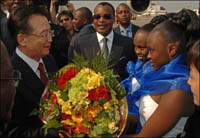 on the resource-rich continent of Africa. The trip, the third by a high-profile Chinese leader to Africa was seen as an atttempt to source energy and mineral supplies for China's booming economy as well as securing markets for its consumer and industrial goods in the African markets.
China and Ghana have also sealed deals worth over US$72 million in loans earmarked for upgrading telecommunications network, and bringing Chinese doctors to Ghana. Bilateral trade between China and Ghana has grown ten-fold over the past decade. China has jumped ahead of Ghana's traditional trading partners India and Britain to become the West African nation's biggest foreign investor.
The high-profilee visits to Africa highlight the growing importance of resource-rich Africa to the world’s most voracious consumer of industrial raw materials.
China’s two-way trade volume with Africa totaled over $346 billion in 2025, and its direct investment in Africa crossed 47 billion. Chinese President Xi Jinping pledged over $50 billion in new financing for African nations over the next three years at the 2024 Forum on China-Africa Cooperation (FOCAC) in Beijing. China has approximately 1,200 assistance projects in Africa. Between 2000 and 2024, Chinese lenders signed 1,319 loan commitments totaling approximately $180.87 billion for African governments and entities
The Chinese government has built its influence in Africa by using its state-owned companies to underbid competitors — including Western companies — for government projects. It is a practice the Organisation for Economic Cooperation and Development’s member states have agreed to avoid, because of the unfair competition that results when government aid mixes with private investment.
“That is not a concern for Beijing. Because China’s objective is to make allies rather than quick profits, it is willing to bid low. Chinese-owned companies keep costs low by relying on cheap labour,” says a Chinese spokesperson.
 The South Africans are leading the charge against China's growing influence in African markets. The apartheid government in South Africa was often seen as supported by the Western countries and white-owned businesses. Many lucrative South African contracts were bagged by Western countries till recently. China is now offering to understake the same projects at a much lower price. This has resulted in accusations of "unfair competition" by some South African business lobbies, particularly the white-owned enterprises.
A few years back, a Chinese company was awarded a R425-million portion of the Vaal River Eastern Sub-system Augmentation Project (Vresap). Together with its partner, Mathe Construction (notably a black-economic-empowerment entity), the Chinese company pitched itself more than 25% lower than local competitors. This annoyed a lot of white-owned businesses in South Africa - expecting the contract should have gone to Western companies or their representatives in South Africa. Notably, South Africa is host to the largest population of Chinese on the African continent, with estimates ranging from 250,000 – 350,000. On the other hand, since the early 1990s, a large number of white South Africans have emigrated, due to concerns over crime and employment prospects, with a number returning in subsequent years.
Before the controversial Vresap contract, some members of the South African construction business industry (mostly from the white minority community not under the black-economic-empowerment bracket) made a representation to South Africa's Department of Trade and Industry when the Indian business tycooon Mittal awarded a large contract at its Newcastle steel mill to Chinese industrial consortium Citic Acre.
In many African countries, governments are finding themselves caught between complaints and pressures from various industrial lobbies and Beijing’s efforts to woo them through competitive prices and quality goods and services.
